
UNIT 6
|
Grammar:
Texts: |
1. The Present Perfect Continuous Tense 2. Word Order 3. Question Words 1. «Are Buses as Easy to Use as Cars?» 2. «Jenny Boyce» 3. Can You Come?» |
Text One
Are Buses as Easy to Use as Cars?
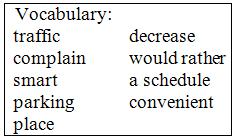 When the weather is cold, it’s not very much fun to wait for a bus. These people have been standing on the corner for fifteen minutes. They’ve been watching the traffic, looking for the bus, and hoping it will come soon. They’ve been talking about the bus and complaining about the weather. Most of them feel cold. One smart man has been drinking coffee to stay warm.
Traveling on buses decreases pollution, but people often would rather drive their cars. Many people aren’t used to the bus schedules, and they don’t like to wait. On the other hand, many people have been taking the bus every day for many years. They’re used to it. They say the bus has been coming on time every day, and they’ve never been late to work. In addition, they haven’t needed a parking place in all that time. Buses are very convenient when you’re used to them.
Text Two
Jenny Boyce
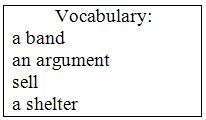 Jenny Boyce has been singing with 3D for two years. ‘The band had an argument last year,’ she said. ‘There used to be six people but now there are only four.’
3D had their first hit record in January. ‘We did everything ourselves,’ said Jenny Boyce. ‘We played all the instruments, ran the studio and produced the record. We even went round the shops ourselves, selling it.’ Pick Me Up sold half a million copies in the first two months and has been selling well since then. ‘We’ve been working on the next record,’ said Jenny. ‘It’s called I need Shelter and it’ll be in shops next month.’
Text Three
Can You Come?
|
Nancy: |
Excuse me, I’m looking for a telephone-box. |
|
Bobby: |
A telephone-box? Let me see... Go straight on... |
|
Nancy: Bobby: |
Yes. Then take the second turning to the left. |
|
Nancy: Bobby: Nancy: Bobby: |
The second turning to the left. Yes. It’s just round the corner. Thank you. Not at all. |
|
Nancy: |
Oh, there’s the telephone-box. Now, let’s look at the instructions. «Have money ready». All right. Here’s a sixpence. «Lift receiver». «Listen for dialling tone». Well, there it is. «Dial carefully, then wait for a tone». B.B.C. - that’s 580 - 4468. 5-8-0-4-4-6-8. That’s it. «Now press in coin». That’s the sixpence going. |
|
Operator Nancy: |
B.B.C. Good morning. May I speak to Mr.Jones, News Department, please. |
|
Operator Nancy: Harold: Nancy: Harold: Nancy: Harold: Nancy: Harold: Nancy: |
One moment, please. Thank you. Jones speaking. Hello, this is Miss Miller speaking. Miss Miller? Oh, it’s you, Nancy. Yes, it’s me. How are you, Harold? Fine, thanks. How are you? I’m fine, thank you. Are you in Hastings at the moment? No, I’m standing in a telephone-box in Charring Cross Road. |
|
Harold: Nancy: |
So you’re in London now. Listen, Harold. Can you come to Hastings next Saturday? |
|
Harold: Nancy: Harold: |
To Hastings? To your family? Yes, it’s Peter’s birthday. A birthday-party? Rather, I’d like that. |
|
Nancy: Harold: |
Can you come, Harold? Yes, of course, Nancy. That’s all right. I’ll come first thing in the morning. |
|
Nancy: Harold: Nancy: Harold: Nancy: |
Good idea, Harold. That’s lovely! But what shall I buy for Peter? Well, he’s fond of reading cowboy books. All right. I’ll get him a cowboy book. Good. Our address is 26 Castle Road. It’s not far from the railway station. |
|
Harold: |
26 Castle Road. Thank you for calling, Nancy. Till then. |
|
Nancy: Harold. |
Till then, Harold. Good-bye. Good-bye. |
Notes. Forms and Patterns
1. The Present Perfect Continuous

|
I have (I’ve) been working you have (you’ve) been working she has (she’s) been working we have (we’ve) been working you have (you’ve) been working they have (they’ve) been working |
have I been working? have you been working? has she been working? have we been working? have you been working? have they been working? |
|
I have not (haven’t) been working you have not (haven’t) been working she has not (hasn’t) been working we have not (haven’t) been working you have not (haven’t) been working they have not (haven’t) been working |
|
(b) We use the Present Perfect Continuous:
1. to express an activity which continues to the present:
|
e.g. |
We’ve been waiting here for hours! It’s been raining for days. |
2. to refer to an activity with a result in the present:
|
e.g. |
I’m hot because I’ve been running. Her shoes are muddy. She’s been digging the garden. |
(с) The Present Perfect Continuous often occurs with «for, since, how long»:
|
e.g. |
It has been raining for two hours. They’ve been watching television since 2 o’clock. How long have you been smoking? |
(d) Types of questions.
|
One man has been drinking coffee to stay warm. |
1. Has one man been drinking coffee to stay warm? 2. Has one man been drinking coffee or tea to stay warm? 3. What has one man been drinking to stay warm? 4. One man has been drinking coffee to stay warm, hasn’t he? 5. Who has been drinking coffee to stay warm? |
2. Word Order.
The most common word order in an English sentence is
|
1) subject 2) verb 3) object 4) adverbials |
When there are several adverbials the normal order is a) manner b) place c) time
|
e.g. |
Our guide speaks English fluently. Tom walks to work every morning. |
It is often possible to put a time adverbial at the beginning of the sentence.
e.g. Every morning Tom walks to work.
3. Question Words.
The words «who», «what», «which», «how many», «how much» can begin two kinds of question.
|
e.g. |
The ball (S) hits the window (O). a) What hit the window? (a question to the subject) b) What does the ball hit? (a question to the object) |
1) Questions can begin with a question word.
|
what who where when which why how whose |
|
e.g. |
How does she go to work? - By train. Where is the station? - In Baker Street. |
2) «What», «Which», and «Whose» can be followed by a noun.
|
e.g. |
What size do you take? Whose book is this? Which coat is yours? |
3) «How» can be followed by an adjective or an adverb.
|
e.g. |
How big is his new car? How fast does it go? |
Drills
|
Drill 1. |
How long have you been living in this house? (since 1970)
|
1. How long has the baby been crying? (all the morning)
2. How long have you been trying to get this book? (for a week)
3. How long have you been discussing this problem? (for 3 hours)
4. How long has she been looking after her little sister? (for 2 years)
5. How long has your brother been watching television? (all the evening)
6. How long has the fire been burning? (all the night)
7. How long has she been helping her mother about the house? (since her childhood)
8. How long has he been sleeping? (for hours)
9. How long has your brother been collecting postage stamps? (since he was in the fifth form).
10. How long has she been practising the piano? (for the last two hours)
|
Drill 2. |
Why are you so dirty? (dig potatoes in the garden)
|
1. Why are her eyes red? (cry)
2. Why are you so angry? (quarrel with Bob)
3. Why is her coat wet? (walk in the rain)
4. Why do you know nothing about Helen’s marriage? (travel)
5. Why haven’t they left the room during the break? (discuss the new play)
|
Drill 3. |
Is John still sleeping? (hours)
|
1. Is Mary still writing letters? (two o’clock)
2. Are you living in Scotland now? (a year)
3. Are you still working for the same company? (I left school)
4. Are they still trying to learn French? (ten years)
5. Are they all sitting in the garden? (lunch time)
6. Is he still playing tennis? (ten o’clock)
7. Is John still waiting for Mary? (more than an hour)
|
Drill 4. |
John is still waiting for Mary.
|
1. They’re all sitting in the garden.
2. He’s still working in that office.
3. We are living in London now.
4. Mary is still staying at the Grand Hotel.
5. Mrs. Smith is still talking to Mrs. Jones.
6. Peter’s still reading that book.
7. That fire is still burning.
Vocabulary and Comprehension Exercises
Exercise 1. (Text 1) Answer the questions.
1. How long have the people been standing on the corner?
2. What have they been doing? (Give five answers).
3. Why has one man been drinking coffee?
4. What are good reasons for taking buses?
5. What are the reasons for driving cars?
6. What are the problems with buses?
7. What are the problems with cars?
Exercise 2. (Text 1) Listen to the sentences below. All are in the present perfect tense. Some of the verbs describe a period of time, and some describe a completed action. If the verb describes an activity over a period of time, change it to the present perfect continuous tense. If it describes a completed action, simply repeat the sentence as it is.
1. He’s bought a ticket already.
2. He’s taken the bus for one month.
3. He’s stood on the corner since 9 a.m.
4. He’s asked the bus driver for a ticket.
5. We’ve caught the bus on the corner every day this week.
6. The bus has come on time every day.
7. We’ve waited for almost an hour.
8. He’s drunk all his coffee already.
Exercise 3. (Text 1) Listen to the sentences. If you can, change the verb phrase to the present perfect continuous tense. If the verb cannot take a continuous tense, simply repeat the sentence as it is.
1. I’ve owned a car for ten years.
2. I’ve driven it to work every day.
3. I’ve never believed that cars are dirty.
4. I’ve always thought that cars are convenient.
5. I’ve taken my car to the enter of the city.
6. I’ve parked very close to my office.
7. It’s taken half an hour to drive to work.
8. I’ve always hated to wait in the cold.
9. I’ve thought about taking the bus in the summer.
10. I’ve waited for a more convenient bus schedule.
11. I haven’t ever had a car.
12. I’ve taken the bus every day for years.
13. I’ve had a lot of fun riding buses.
14. The schedule has been convenient for me.
15. The bus has come on time every day.
16. I’ve always liked the buses.
17. I’ve ridden with the same bus driver for two years.
18. I’ve said hello to him every morning.
19. The air has seemed polluted this week.
20. The weather has felt cold all week.
Exercise 4. (Text 2) Answer the questions.
1. What does Jenny do?
2. What’s the band called?
3. How many people are in it?
4. What’s the name of their latest record?
5. Is it very successful?
6. What’s their next record called?
7. How long has Jenny been singing with the band?
Exercise 5. (Text 3) Answer the questions.
1. What is Nancy looking for?
2. What number is Nancy dialing?
3. Who does Nancy want to speak to?
4. Where is Nancy standing?
5. When is Peter’s birthday?
6. Can Harold come?
7. What is Peter fond of?
8. What is Nancy’s address?
9. Is it far from the railway station?
Exercise 6. Dictation-translation.
1. Когда на улице холодно, ждать автобуса - не очень приятно.
2. Эти люди стоят на остановке уже 15 минут, внимательно следят за уличным движением и жалуются на погоду.
3. Использование автобусов уменьшает загрязнение окружающей среды, но люди предпочитают ездить на своих машинах.
4. Многие пользуются автобусами много лет и привыкли к этому.
5. Им нет необходимости искать место для парковки все это время.
Grammar Exercises
Exercise 1. Make the following sentences: a) interrogative; b) negative.
1. They’ve been waiting for half an hour.
2. She has been wearing glasses since she was ten.
3. It has been raining for two days now.
4. I have been working in the laboratory since October.
5. They have been walking for three hours.
6. He has been teaching in this school since 1985.
7. We have been fishing for two hours.
8. They have been living in France since 1980.
Exercise 2. Add «since» or «for»:
1. He has been selling cars ..... ten years.
2. He has been living here .... 1934.
3. I’ve been waiting ..... five o’clock.
4. We’ve been reading this book ..... last January.
5. We’ve been studying English ..... three months.
6. He has been sleeping ..... seven hours.
7. He has been working ..... seven o’clock this morning.
8. They’ve been very busy ..... the last week.
9. My friend has been ill ..... a long time.
10. It has been raining ..... yesterday morning.
11. That church has been standing here ..... centuries.
12. She has been teaching in that school ..... 1978.
13. I’ve been working in this office ..... a month.
14. That man has been standing there ..... six o’clock.
15. The kettle has been boiling ..... a quarter of an hour.
16. I’ve been trying to open this door ..... forty five minutes.
Exercise 3. Make sentences with the Present Perfect Continuous tense.
|
e.g. |
How long/ you/ wait? How long have you been waiting? |
1. I/ try/ to phone him all day.
2. We/ live/ in this house for about twelve years.
3. Janet/ practise/ the violin all afternoon.
4. I/ wait/ for a letter from my father for weeks.
5. How long/ you/ learn/ English?
6. People/ fight/ each other for millions of years.
7. They/ talk/ for a long time.
8. It/ rain/ since I got up this morning.
Exercise 4. Complete the sentences by putting the parts in brackets in the order:
object + manner + place + time.
1. She can play ..... (now/ very well/ the piano).
2. The children have been playing ..... (this afternoon/ in the park/ football).
3. We work ..... (at school/ hard/ every day).
4. They live ..... (on Main Street/ now).
5. I’ll meet you ..... (at 10 o’clock/ in front of the office).
6. Johnny goes ..... (early/ to school).
7. Mr. Jones is coming ..... (right now/ up the street).
8. We are going camping ..... (this summer/ in the mountains).
9. She stays .... (at home/ every day).
10. I saw you ..... (this morning/ at the library).
Exercise 5. Put the sentences in right order.
1. took/ the children/ from the cupboard/ some cakes/ after breakfast.
2. loudly/ in the bath/ sings/ he/ always.
3. The Hunts/ one car/ got/ only/ have/ now.
4. was born/ in the morning/ at 2 o’clock/ 1994/ the baby/ on 3d June.
5. Usually/ come/ the students/ noisely/ out of class/ at four o’clock..
6. sings/ beautifully/ that song/ Jean/ generally.
7. music/ likes/ very much/ classical/ my father.
8. understand/ very well/ they/ French/ but/ don’t speak/ they/ it/ easily/ very.
Exercise 6. Put the verbs into the Present Perfect Continuous form:
|
A.:
B: |
1. I (live) here since 1928. 2. The cat (sit) in front of the fire since tea-time. 3. I (look) at this picture for five minutes, but I can’t see you in it. 4. I’m afraid you (look) at the wrong one. 5. You (wait) long for me? 6. Yes! I (stand) here in the rain for half an hour. 7. He (learn) English for three years, but he can’t even read a newspaper yet. 8. Nobody has come to see us since we (live) in our new house. 9. He (work) in the Post Office for twenty years. 10. Lunch is not quite ready yet, although I (cook) all the morning. 11. They are tired because they (work) in the garden since nine o’clock. 12. Look! That light (burn) all night.
1. I (bathe). That’s why my hair is all wet. 2. You (drive) all day. Let me drive now. 3. I’m sorry for keeping you waiting. I (try) to make a telephone call to Rome. 4. He (overwork). That is why he looks so tired. 5. He (study) Arabic for two years and doesn’t even know the alphabet yet. 6. I (make) cakes. That is why my hands are all covered with flour. 7. How long you (wait) for me? - I (wait) about half an hour. 8. Have you seen my bag anywhere? I (look) for it for ages. 9. Your fingers are very brown. You (smoke) too much. 10. Tom (dig) in the garden all afternoon and I (help) him. 11. I (shop) all day and I haven’t a penny left. 12. We (live) here since 1990. |
Exercise 7. Use Present Perfect or Present Perfect Continuous.
1. I (sit) here waiting for you for nearly an hour. I (already drink) four whiskies.
2. What (you do) all this time? I (not see) you for weeks.
3. They (not work) for several days now. They (be) too ill.
4. It (not rain) for a month now. The grass is very dry.
5. They (go) to this pub every evening for the last 10 years.
6. I (sleep) for the last two hours and I (not wake) up properly yet.
Exercise 8. Use the question words below to complete the questions which follow:
|
what when where which who whose why how |
1. ..... time do you finish work?
2. ..... is it who lives in that big house?
3. ..... of these coats belong to you?
4. ..... advice would you give to someone about to leave school?
5. ..... old is your daughter now?
6. ..... exactly did you buy that lovely dress? In London?
7. I haven’t seen George for ages. ..... did you last come across him?
8. ..... bag is this? It’s not yours, is it?
9. About ..... long does it take to get to Birmingham?
10. ..... do you get to the post office from here?
11. ..... did you live before you came to London?
12. But ..... can’t you come? Are you busy?
13. ..... day does Dad get home?
14. I don’t know. ..... do you ask?
Exercise 9. Make questions from these sentences by using «who» or «what» instead of the underlined words.
1. George bought her that necklace. Who .....
2. George bought her a necklace. What .....
3. They have invited Mary and Philip. Who ....
4. I’ve lent that book to Bill. Who .....
5. They gave the keys to Peter. What .....
6. My daughter answered the telephone. Who .....
7. The manager said no. What .....
8. I asked Andrew to help. Who .....
9. We can send a bunch of flowers. What .....
10. The children will be at home. Who .....
Exercise 10. Add a question-word to the following questions:
|
1. .... is your name? 2. .... is that pretty girl? 3. .... is your telephone number? 4. .... trees grow in Egypt? 5. .... is yours, the orange or the banana? 6. .... colour is it? 7. .... makes tea sweet? 8. .... wants a piece of bread? |
9. .... understands this exercise? 10. .... is the answer to my question? 11. ....of these books is your favourite? 12. .... is wrong with the clock? 13. .... bus goes to Charing Cross? 14. .... is smoking here? 15. .... is the largest town in the world? 16. .... has happened? |
Exercise 11. Tony is being interviewed for a job. Look at the interviewer’s notes and Tony’s answers, then write the questions she is asking Tony.
|
1. age? 2. live locally? 3. address? 4. which school/ go? 5. work/ now? 6. who/ work for? 7. how long? 8. enjoy/ present job? 9. why/ want/ leave? |
1. I’m 18. 2. Yes, I do. 3. 5, Flower Close. 4. Benham School. 5. Yes, I am. 6. Millers Limited. 7. For six months. 8. yes, I do. 9. The pay isn’t good. |
Exercise 12. Complete the sentences with the correct question word.
|
Who Why When What Where Whose How |
1. ...’s that man over there with the beard?
|
2.
3. 4.
5. 6. 7.
8. 9. |
A: ... can you come and stay for the weekend? B: Next month, possibly. ... long does it take you to get to work in the morning? A: ... can I buy some fresh milk? B: At the shop on the corner. ...’s your new boss like? ... keys are these? I’ve found them on the floor. A: ... do you like living in York? B: Because the people are very friendly here. ... much is that large box of chocolates? ...’s the name of the travel agent’s name here? |
Exercise 13. Use the words in brackets to write the correct questions for each answer.
Example: (start work) At 7.30 in the morning. - What time do you start work?
|
1. (get to work) 2. (journey take) 3. (far) 4. (park your car) 5. (finish work) 6. (your wife work) 7. (do after supper) 8. (go to bed) |
By car. About three quarters of an hour. Five kilometres. In the factory car park. At 5 p.m. No, she doesn’t. We watch TV. At about 11 o’clock. |
Exercise 14. Translate from Russian into English.
1. Мне жарко, потому что я бежал.
2. Дождь идет уже три часа.
3. Наш экскурсовод бегло говорит по-английски.
4. Как долго вы обсуждаете этот вопрос?
5. Почему у тебя пальто мокрое? - Потому что я шел под дождем.
6. Ты все еще работаешь в той же фирме? - Да, я там работаю с тех пор, как закончил школу.
7. Генри все еще ждет Мэгги. - Как долго он ее ждет?
8. Которое пальто твое?