
UNIT 5
|
Grammar:
Texts: |
1. The Present Perfect Tense 2. Possessive Case 1. «Loch Ness» 2. «Man’s Best Friend» 3. «Can I Help?» |
Text One
Loch Ness
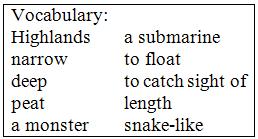 Loch Ness is a large lake in the Highlands of Scotland. It’s narrow and quite deep, nearly 300 metres. There is a lot of peat in it, so it’s very black.
People have said and believed for hundreds of years that there is a monster in the lake. Fifty years ago they built a new road along the lake and since then people have reported that they have seen the monster. There have also been expeditions with small submarines and underwater cameras to try and find out more about the monster.
In some interesting underwater photos from 1975 you can see a head and a big body. But not everybody believes that there really is a large animal in the loch. Some people say that it’s only peat, which is rising from the bottom of the lake, or branches of trees which are floating in the water. And yet there are people who keep watch day and night all summer in the hope of catching sight of Nessie, if and when she raises her head.
This is what the monster, Nessie, looks like, if you believe what the photos show you: it’s dark brown, its total length is about 15 metres and its head is very small and snake-like.
People say that the best time to see the monster is in the summer months, early in the morning and evening, when the weather is warm and the loch is calm.
Text Two
Man’s Best Friend
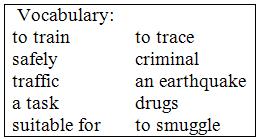 Dogs are nice to play with and they are good company. You can also train them to be hunting-dogs, sheep dogs and many other things.
Most of us have seen guide dogs with blind people, who can move safely in the streets with their help. The dogs have learnt to stop for traffic, they know when it’s safe for their master to cross the street and they «tell» him about things in his way.
It takes a long time to train a dog for these tasks, and all dogs are not suitable for training. The dog must be intelligent, have a nice temperament and be willing to co-operate.
When the dog is one year old, the real training for its special task begins. Some dogs become police dogs. They learn to trace people who are lost, to stop criminals from running away from the police and to find people who are buried under the ruins of a house after an earthquake, for example. The dogs’ very fine sense of smell helps them to do this.
Other dogs learn to trace drugs. Nowadays these dogs are becoming more and more important, when the smuggling of drugs is increasing. Some people believe that the dogs learn to trace drugs because they are drug addicts themselves. This idea is quite wrong. The dogs could not do their important job for years if they were dependent on drugs.
The trainer hides the drugs in more and more difficult places, but the dogs find them every time. They can even «smell» drugs which people have hidden in metal containers.
These useful dogs are worth their weight in gold to the people who have trained them. But above all, dogs are good company for many people who like to have them to talk to.
Text Three
Can I Help
|
Harold: Nancy: Harold: Nancy: Harold: Nancy:
Harold: |
This is a nice restaurant, isn’t it? Yes, it’s very pleasant here near the window. And the cakes are very good, too. Mmm..... Yes, they are. I like these cakes very much. Another cup of tea, Nancy? Yes, please. Thank you. I’ve got some snaps of the family with me. Some snaps? I like to see them. Oh, these are good photographs. Is this your father? |
|
Nancy: |
Yes, that’s my father. He’s the commander of a hovercraft. |
|
Harold: Nancy: Harold: Nancy: Harold: Nancy: Harold: Nancy: Harold: Nancy: Harold: Nancy: Harold: Nancy: Harold: Nancy: Harold: Nancy: Harold: Nancy: Harold: Nancy: |
Really? Fantastic! So you’re a commander’s daughter. Yes, indeed. And who is this lady? That’s my mother. She is a commander’s wife. Is she a housewife? Yes, that’s right. She is at home all day. Who is this boy? That’s Peter. He is my dear brother. Oh, your brother! How old is he? He is 12 years old now. He is still at school. Who is that girl? It’s Peter’s sister. Why ... It’s you, Nancy. You are Peter’s sister. Yes. Do you like the picture, Harold? Of course. I like it very much. Well, then. You can keep it. Thanks. And here’s my photograph for you. Oh, great! Thank you, Harold. Another cup of tea? No, thank you. Look, here’s my last snap. Who is this policeman? It’s my uncle David. He’s my mother’s brother. Oh, Harold. What’s that? |
|
Harold: Nancy: Harold: Nancy: Harold: Nancy: |
It’s an accident. Let’s go and help. Help? How can we help? Well, I am a nurse after all. Come on! Goodness! Look at that bus! Excuse me, constable. Can I help? I am a student nurse. |
|
Constable: |
Certainly. There’s an old man in the bus, his leg’s broken. |
|
Nancy: Constable: Old man: |
Let me see. Move along, please. Oh, my leg. My leg. |
|
Nancy: |
It’s all right, sir. The ambulance is coming in a few minutes. |
|
Constable: Ambulance: Nancy: Constable: |
Here’s the ambulance. Move along, please. We are taking the man to the hospital now. All right. Be careful. His leg is broken. Move along, please. |
|
Harold: Nancy: |
Well, Nancy. How are things? A man broke his leg. He’s in the ambulance now. He’s going to hospital. |
|
Harold: Nancy: Harold: Nancy: Harold: Nancy: |
Oh, Nancy. You are wonderful. Well, it’s my job. Come on. And now for the cinema. Look, here’s the cinema. What’s the big picture? It’s called «Accident in Cannon Street». Well, I never ..... |
Notes: Forms and Patterns
1. The Present Perfect Simple
|
have/has |
+ |
verb |
+ |
-ed |
(past participle) |
(a) Form:
|
I have (‘ve) asked you have (‘ve) asked he/she/it has (‘s) asked we have (‘ve) asked you have (‘ve) asked they have (‘ve) asked |
Have I asked? Have you asked? Has he asked? Have we asked? Have you asked? Have they asked? |
I have not (haven’t) asked you have not (haven’t) asked she has not (hasn’t) asked we have not (haven’t) asked you have not (haven’t) asked they have not (haven’t) asked |
Some verbs are ‘regular’; other verbs are ‘irregular’:
|
|
e.g. work - worked; live - lived |
|
|
e.g. come - come; be - been |
(For a list of irregular past participles see Appendix 2)
(b) We use the Present Perfect Simple:
1. to express an activity at some non-specific time in the past with a result in the present or future:
|
e.g. |
He’s broken a cup I’ve seen this film. |
2. to express experiences:
|
e.g. |
I’ve travelled a lot in Africa. They’ve lived all over the world. |
«Ever» and «never» are common with this use.
3. to express an activity within a period of time which is not yet finished:
|
e.g. |
I’ve written six letters this morning. |
4. to express an action or state which began in the past and continues to the present:
|
e.g. |
I’ve known Alice for six years. How long have you worked as a teacher? |
(с) The Present Perfect Simple often occurs with «just, yet, already, never, ever, so far, up to now, lately, of late»:
|
e.g. |
Don’t forget to post the letter. - I have already posted it. He has just arrived. I haven’t told them about the accident yet. |
The adverbs «just, already, never» normally go after the auxiliary verb «have»:
|
e.g. |
The taxi has just arrived. |
The adverbs «yet, lately, so far, up to now, this year, this month» normally go at the end of a sentence:
|
e.g. |
They haven’t finished dinner yet. |
The adverb «already» can also go at the end of a sentence for emphasis:
|
e.g. |
I’ve done it already. |
(d) The Present Perfect Simple can be translated into Russian in two ways:
|
e.g. |
People have believed that there is a monster in the lake. - Люди верят, что в озере есть чудовище. This man has just broken his leg. - Этот человек только что сломал ногу. |
(e) Types of questions:
|
The dogs have learnt to stop for traffic. |
1. Have the dogs learnt to stop for traffic? 2. Have the dogs learnt to stop for traffic or to trace drugs? 3. What have the dogs learnt to do? 4. The dogs have learnt to stop for traffic, haven’t they? 5. Who has learnt to stop for traffic? |
2. The Possessive Case
A. The ‘s form.
1) Formation:
|
By adding apostrophe and s (‘s) |
David’s sister women’s liberation Dickens’s novels John and Mary’s wedding |
to singular nouns to plural nouns in -en to proper nouns ending in -s to groups of nouns treated as one word |
|
By adding apostrophe without s (‘) |
the boy’s room Jesus’ death |
to plural nouns in -s to classical nouns ending in ‘s |
2) Use of the ‘s form:
|
Mary’s books a spider’s web the government’s policy |
to express possession of nouns denoting living being: (people + animals) and collective nouns |
|
five minutes’ walk today’s newspaper London’s theatres |
with nouns expressing time, space, measure |
B. Use of the of-form.
|
The door of the classroom |
with things |
|
the Prince of Wales the Tower of London the battle of Waterloo |
set expressions |
|
a row of books hundreds of people a glass of milk |
with partitive meaning |
Drills
|
Drill 1. |
Have you seen him?
|
1. Have you been to the Zoo?
2. Have you lived here all your life?
3. Have you had your dinner?
4. Have you learnt the Perfect tenses before?
5. Has the bell gone?
6. Has the lesson begun?
7. Have you been up in a helicopter?
8. Have you ever played tennis?
9. Have you ever ridden a horse?
10. Have you driven a car?
11. Have you ever written a letter to a newspaper?
12. Have you ever eaten a frog?
13. Have you ever driven a tractor?
14. Have you ever broken your leg?
15. Have you ever had an operation?
16. Have you ever eaten a fishburger?
17. Have you ever eaten Chinese food?
18. Have you ever slept in the park?
|
Drill 2. |
a new film
|
|
1. an English magazine 2. an interesting article 3. a scientific journal 4. a hippopotamus |
5. an elephant 6. a camel 7. a tiger 8. a lion |
|
Drill 3. |
his brother
|
|
1. a student from Group 7 2. his parents 3. his teacher 4. his Dean |
5. his friend 6. his neighbour 7. the postman 8. a fashion model |
|
Drill 4. |
Have you been to Mexico? - (No)
|
|
|
Have you spoken to the manager? - (Yes).
|
1. Have you been to the cinema lately? - (Yes).
2. Have you gone skiing this winter? - (No).
3. Have you had your breakfast already? - (Yes).
4. Have you ever been to Italy? - (No).
5. Has the class started? - (Yes).
6. Have you decided where to go yet? - (No).
7. Have we spent all our money? - (Yes).
8. Have you ever spoken to a famous person? - (No).
9. Have you read «Hamlet?» - (Yes).
10. Have you ever been to Disneyland? - (No).
|
Drill 5. |
My sister has been a good pupil. (always)
|
1. She has been late for classes. (never)
2. He has told us about his work. (already)
3. I have seen an elephant. (never)
4. She has come in. (just)
5. They have heard of it. (never)
6. We have finished this exercise. (almost)
7. I have done my homework. (already)
8. She has learned to swim. (just)
|
Drill 6. |
to drive a car
|
|
1. to play tennis 2. to ride a horse 3. to take photoes 4. to use the make-up 5. to travel by ship 6. to change one’s mind 7. to see an elephant |
8. to lose the passport 9. to win a lot of money 10. to travel round the world 11. to clean the car 12. to make the coffee 13. to cook the dinner 14. to get pocket money
|
|
|
Drill 7. |
Tom is opening the door.
|
|
1. Harry is changing his clothes.
2. I am washing my hands.
3. We are listening to the news.
4. You are speaking over the telephone.
5. He is having breakfast.
6. They are returning books to the library.
7. We are buying a tape-recorder.
8. Peter is washing his car.
9. Harold is repairing our TV set.
|
Drill 8. |
Why aren’t you doing the exercise?.
|
1. Why aren’t you reading the text?
2. Why aren’t you doing your homework?
3. Why aren’t you listening to the news?
4. Why aren’t you getting ready for the exams?
5. Why aren’t you having dinner?
6. Why aren’t you drinking milk?
7. Why aren’t you cooking supper?
|
Drill 9. |
Does that ring belong to your wife?
|
1. Does this coat belong to James?
2. Do these books belong to the girls?
3. Does your journey take three days?
4. Does this hat belong to your uncle?
5. Does that house belong to John and Mary?
6. Have you read all the novels Dickens wrote?
Vocabulary and Comprehension Exercises
Exercise 1. (Text 1) Answer the questions with a sentence from the text.
1. What is Loch Ness?
2. Is it wide and shallow?
3. Why is it very black?
4. What is there in the lake?
5. What for have there been expeditions?
6. What can you see in some interesting underwater photos from 1975?
7. Does everybody believe that there really is a large animal in the loch?
8. What do some people say?
9. Why do some people keep watch day and night all summer?
10. What does the monster, Nessie, look like?
11. What is the best time to see the monster?
Exercise 2. (Text 2) Answer each question with a complete sentence.
1. What can you train dogs to be?
2. What have guide dogs learnt to do?
3. What do they know?
4. Does it take a long time to train a dog?
5. What dogs are suitable for training?
6. When does the real training for a dog begin?
7. What do police dogs learn to do?
8. Why are the dogs tracing drugs becoming more and more important?
9. Where does the trainer hide the drugs?
10. Are these useful dogs worth their weight in gold?
Exercise 3. (Text 3) Answer the questions:
1. Does Nancy like the cakes?
2. What has Nancy got?
3. What is Nancy’s father?
4. What is Nancy’s mother?
5. How old is Nancy’s brother?
6. What is Uncle David?
7. What is Nancy by profession?
8. What’s the matter with an old man in the bus?
9. Where is the ambulance taking the man to?
|
Exercise 4. |
Read the text and answer the questions on the text. Guess the meaning of the underlined words. |
Hitch-hiking
Hitch-hiking was once a cheap and friendly way to travel but nowadays it is quite dangerous. You often hear stories of hitch-hikers who are attacked or murdered by drivers, or of drivers who are robbed by hitch-hikers. Because of this, hitch-hiking is not allowed in many countries.
Danny, 15, a schoolboy.
«I live in the country. I often hitch-hike into town to save money. I always get lifts from people I know but sometimes I have to wait quite a long time».
Paul, 20, a student.
«I’ve hitch-hiked for three years, I’ve been all over Europe. I enjoy it. You meet a lot of people and visit many interesting places».
Susan, 42, a housewife.
«I don’t like it. I think it’s dangerous. None of my children are allowed to do it. I prefer to buy them a train ticket than let them hitch-hike».
Kerry, 19, a nurse.
«I’ve hitch-hiked since I was sixteen. I don’t go alone. I go with my boy-friend or a girlfriend. My mum hates it but I’ve never had any bad experiences. I know how to look after myself».
Answer the questions:
1. Is hitch-hiking only dangerous for hitch-hikers?
2. Is hitch-hiking allowed in all countries?
3. Would you choose hitch-hiking as the way to travel? Give reasons.
|
Danny 1. Where does he live? 2. Why does he hitch-hike? 3. Does he always get a lift at once? |
Susan 1. What does she think of hitch-hiking? 2. Do her children hitch-hike? 3. What does she prefer to do? |
|
Paul 1. How long has he hitch-hiked? 2. Where has he been? 3. Does he like it? Why? |
Kerry 1. How long has she hitch-hiked? 2. Does she hitch-hike alone? 3. Has she ever had any bad experiences? |
Exercise 5. Dictation-translation.
1. Еще чашку чая?
2. Боже мой! Посмотри на этот автобус.
3. Могу ли я чем-нибудь помочь?
4. Скорая помощь придет через пару минут.
5. Осторожно! У него сломана нога.
6. Как дела?
7. А теперь - в кино.
8. Надо же .....
9. Люди говорят и верят уже несколько столетий, что в озере живет чудовище.
10. На некоторых интересных подводных снимках 1975 года вы можете видеть голову и большое туловище.
11. Некоторые люди считают, что это всего лишь ил, который поднимается со дна озера, или ветки деревьев, которые плывут по воде.
12. И все же есть люди, которые не спускают глаз днем и ночью все лето, в надежде хоть краешком глаза увидеть Несси.
13. Чтобы подготовить собаку для специальных заданий, требуется много времени.
14. Собака должна быть умной, иметь хороший характер и желание сотрудничать.
15. Собаки учатся отслеживать людей, которые потерялись, препятствовать преступникам, когда же убегают от полиции, и находить людей, погребенных под развалинами дома после землетрясения.
Grammar Exercises
|
Exercise 1. |
Comment on the use of the Present Perfect Tense. Which use is expressed in the following sentences: a) recent events b) experiences c) actions or states which began in the past and continues to the present |
1. I have known Alice for 5 years.
2. Karen has just passed her exams.
3. We’ve bought a new car.
4. My mother has never travelled by air.
5. I can’t find my umbrella. Somebody has taken it.
6. I’ve lost my passport.
7. «Are they still having dinner?» - «No, they’ve finished».
8. How long have you worked as a teacher?
9. Look! Somebody has broken that window.
10. She is an interesting person. She has done many different jobs and has visited many countries.
11. They have lived all over the world.
|
Exercise 2. |
Make the following sentences |
a) interrogative b) negative.
|
1. Helen’s father has been an engineer for twenty years.
2. Robert has gone to Brazil.
3. The children have come back from school.
4. Mrs Parker has made coffee.
5. I have had lunch.
6. The bus has stopped.
7. The lecture has begun.
8. The boy has fallen asleep.
9. Sheila has bought a new coat.
10. Mr Jones has found his pen.
Exercise 3. Make affirmative or negative sentences without changing the verb.
|
The students Alice Peter We The Parkers Paul They The child I |
hasn’t done the work haven’t seen Michael have been here has met her twice have been Anne’s friends has lived in Paris has done much work has been ill haven’t called up Sam have known George has gone to bed have prepared their homework has come back from the theatre |
of late lately yet this week today since 9 o’clock for a week for ten years already |
Exercise 4. Complete the following sentences with the given alternatives using «for» and «since».
|
1. I haven’t seen you. 2. We’ve been here. 3. She hasn’t spoken to me. 4. They have lived in this street. 5. I haven’t had time to do it. 6. We haven’t bought any new ones. 7. I haven’t eaten any meat. 8. There hasn’t been a famine here. 9. Nobody has written to me. 10. I haven’t spoken Spanish. 11. You haven’t sent me any money. 12. It hasn’t rained here. |
Christmas/three days an hour and a half/January more than two years/last week 1919/the last ten years/a long time I was ill/last Monday a week/ages/then over a year/I was a boy centuries/the Middle Ages many weeks/my birthday 1955/ten years last Saturday/fifteen days more than a month/March |
Exercise 5. Make up sentences using the Present Perfect Tense.
1. He, never, to London, been, before, has.
2. We, seen, a friend of ours, just, have.
3. She, a letter, written, her, to, parents, lately, has.
4. I, interesting, have, a book, very, read, this week.
Exercise 6. Make appropriate questions.
1. I have turned on the lights because it’s getting dark.
2. I have lived in New York since 1985.
3. Henry and Bess have gone to Niagara Falls for their honeymoon.
4. I have seen the film twice already.
5. I have known Uncle Tom all my life.
6. He has bought a new car.
7. The Parkers have been our neighbours for seven years.
8. The secretary has typed the report.
|
Exercise 7. |
Turn the following sentences into: |
a. Present Continuous b. Present Perfect |
1. They ride horses.
2. He takes a taxi to his flat.
3. She sweeps out of the room.
4. Susan lays the table.
5. I give the message to Mrs Green.
6. We send a birthday present to her.
7. We give some old cornflakes to the birds.
8. Mum and Dad watch television.
9. Tina writes letters.
10. Paul makes tea.
11. She teaches us mathematics.
Exercise 8. «Is» or «has»?
|
1. She’s 37. 2. It’s late. 3. He’s 1m 85cm tall. 4. She’s got blue eyes. 5. He’s wearing a dark suit. 6. She’s hungry. |
7. He’s cold. 8. What’s he done? 9. What colour’s your new car? 10. She’s gone to London. 11. She’s tired. 12. Here’s the ambulance. |
Exercise 9. Put the verbs in brackets into the Present Perfect Tense.
1. He just (go) out.
2. Someone (take) my bicycle.
3. The phone (stop) ringing.
4. I just (wash) that floor.
5. The cat (steal) the fish.
6. There aren’t any buses because the drivers (go) on strike.
7. I (live) here for ten years.
8. I (buy) a new carpet. Come and look at it.
9. Would you like some coffee? I just (make) some.
10. I (not pay) the telephone bill yet.
Exercise 10. Give the ‘s form of the possessive.
|
1. The father of James 2. The clothes of the boys 3. The coat of the boy 4. The club of the women 5. The fur of the fox |
6. The poems of Keats 7. The Park of St James 8. The wedding of William and Mary 9. The hats of ladies 10. The toys of my children |
Exercise 11. Put into the possessive.
|
1. Henry James ..... novels 2. children ..... thousands 3. Helen ..... a colleague 4. sugar ..... lump |
5. tomorrow ..... newspaper 6. walk ..... ten minutes 7. Shakespeare ..... poem 8. wine ..... a bottle |
Exercise 12. Complete the table. Fill in the missing singular, singular possessive, plural, and plural possessive forms.
|
1. |
parent |
parent’s |
parents |
parents’ |
|
2. |
|
pilot’s |
|
|
|
3. |
|
|
wives |
|
|
4. |
mouse |
|
|
|
|
5. |
|
boss’s |
|
|
|
6. |
|
|
babies |
|
Exercise 13. Fill in the blanks with a noun form from the parentheses.
1. Whose book is this? It’s the teacher’s. (teacher’s, teachers)
2. Whose toothbrush is that? It’s my ..... (sister’s, sisters’)
3. Whose lunch boxes are those? They’re the ..... (worker’s, workers’)
4. What do they sell there? They sell ..... (flower, flowers)
5. What do the children laugh at? The funny ..... (clowns, clowns’)
6. What have they bought? A pair of ..... (shoe, shoes)
7. Who uses this book? The ..... (teacher, teacher’s)
8. Who has left these shoes here? The ..... (children, children’s)
9. Whose children are those? They’re that ..... (woman’s, women’s)
10. Have you called your sister? No, the ..... wasn’t working. (phone, phones)
11. Does she want to be a nurse? - No, a ..... life is hard. (nurse, nurse’s)
Exercise 14. Fill in the blanks with another form of the underlined noun.
1. Mr Kidd has a son in the army and two sons in the navy.
2. Our family have lunch in the park on Sunday. Many ..... are there.
3. A woman asks the clerk, «Where do you have .... hats?»
4. Herb and Oliver have new bikes. ..... bike is green.
5. Your teacher is not in school. She’s at a ..... meeting today.
6. My wife wants to go to the party. Many ..... don’t want to go.
7. Today is Sunday. This month has five ..... .
8. One farmer’s house is on fire. All the other ..... help him.
9. He has fourteen cows. One ..... leg is broken.
10. The boss will be here soon. Don’t sit there; that’s the ..... chair.
Exercise 15. Translate from Russian into English:
1. Что случилось?
2. Я уже прочитала эту книгу.
3. Начался дождь.
4. Я его еще не видела.
5. Сегодня я не была в библиотеке.
6. Я не встречала его с весны.
7. Я проработала здесь уже 5 лет.
8. Сколько лет ты живешь на этой улице?